Learn how to spot neglect fast by checking oil, coolant, belts, hoses, and a few bonus items safely, even if you are not a mechanic.
Used Car Buying Guide
DIY Engine Fluid Checklist for Used Cars
Check a used car’s oil, transmission fluid, coolant, and brake fluid in minutes. Use this DIY checklist to spot neglect, leaks, and expensive problems before you buy.

Ben Sullivan
Ben Sullivan is a former ASE-certified mechanic with over 15 years of experience inspecting, repairing, and appraising used vehicles. He contributes to Car Wise Guide to help everyday buyers navigate the used car market with confidence, armed with the knowledge to spot hidden red flags and negotiate fair prices.
Published October 18, 2026
Updated October 18, 2026
If you only have time for one under-the-hood check before buying a used car, fluids are one of the best places to start. Fluid condition tells a story: overheating, skipped maintenance, internal wear, leaks, or a seller trying to hide a problem with fresh top-offs.
I’ll walk you through what to look for and what should make you pause. You do not need special tools. You just need good light, a clean paper towel, and the confidence to say, “Let’s pop the hood.”
Quick prep (2 minutes)
- Bring: paper towels or napkins, a small flashlight, and disposable gloves if you want.
- Park level: fluid levels read best on flat ground.
- Ask about warm vs. cold: some checks are best cold (coolant), some are easier warm (automatic transmission fluid on certain cars).
- Safety first: keep hands, sleeves, and jewelry away from belts and fans. If the engine is hot, do not open the coolant cap.
Pro tip: If the seller refuses basic checks like pulling a dipstick or opening a reservoir, treat that like a red flag. You are buying the whole car, not just the paint.
Also: avoid getting fluids on your skin if you have sensitivities, and wash your hands after. A little caution beats a ruined shirt or a rash.
The fast fluid scan
Before we go fluid by fluid, take 10 seconds and look for clues:
- Puddles or wet spots under the engine or transmission.
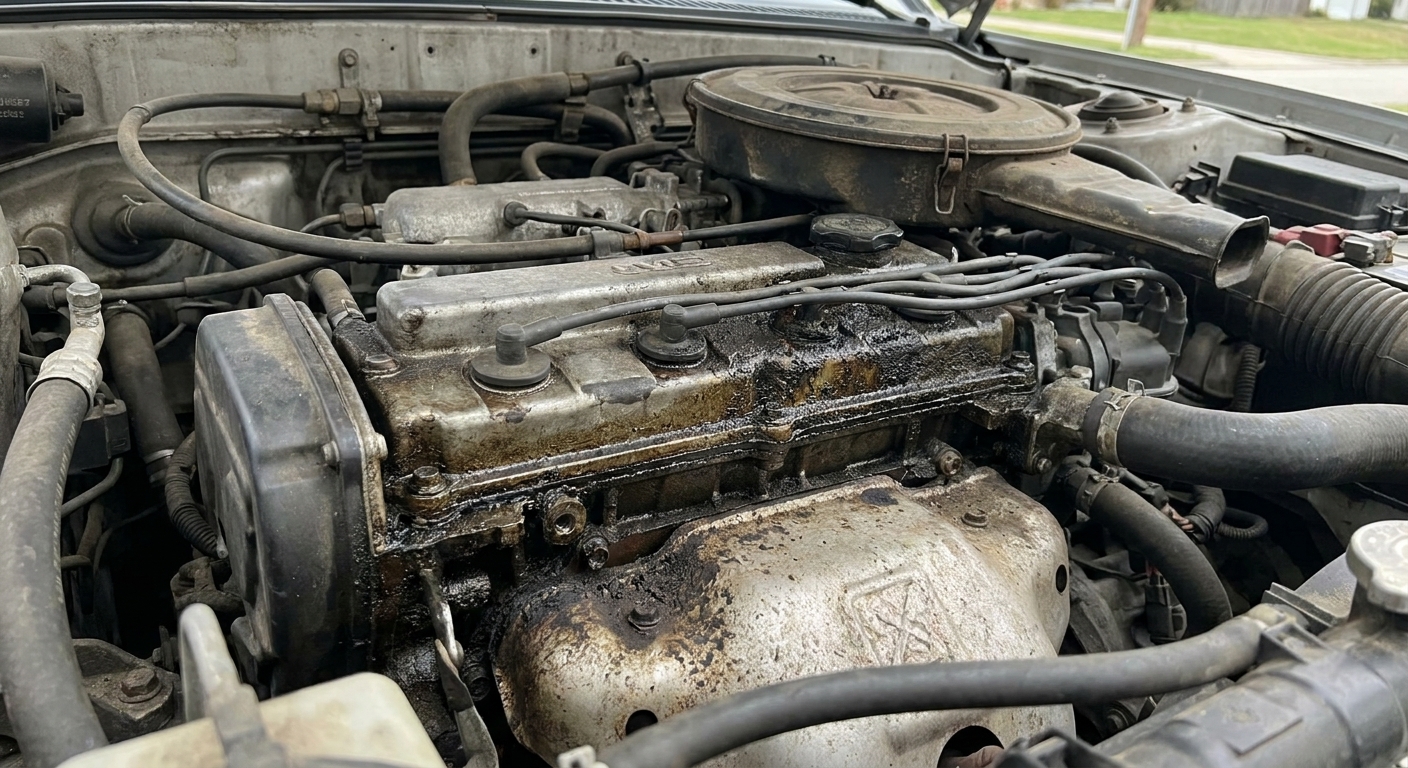
- Oily grime caked on the engine, subframe, or around the oil pan.
- Freshly cleaned engine bay that still smells like solvent, especially if there is no maintenance paperwork. A clean engine is not bad, but a recently washed engine can hide leaks until after your test drive.
Engine oil
How to check
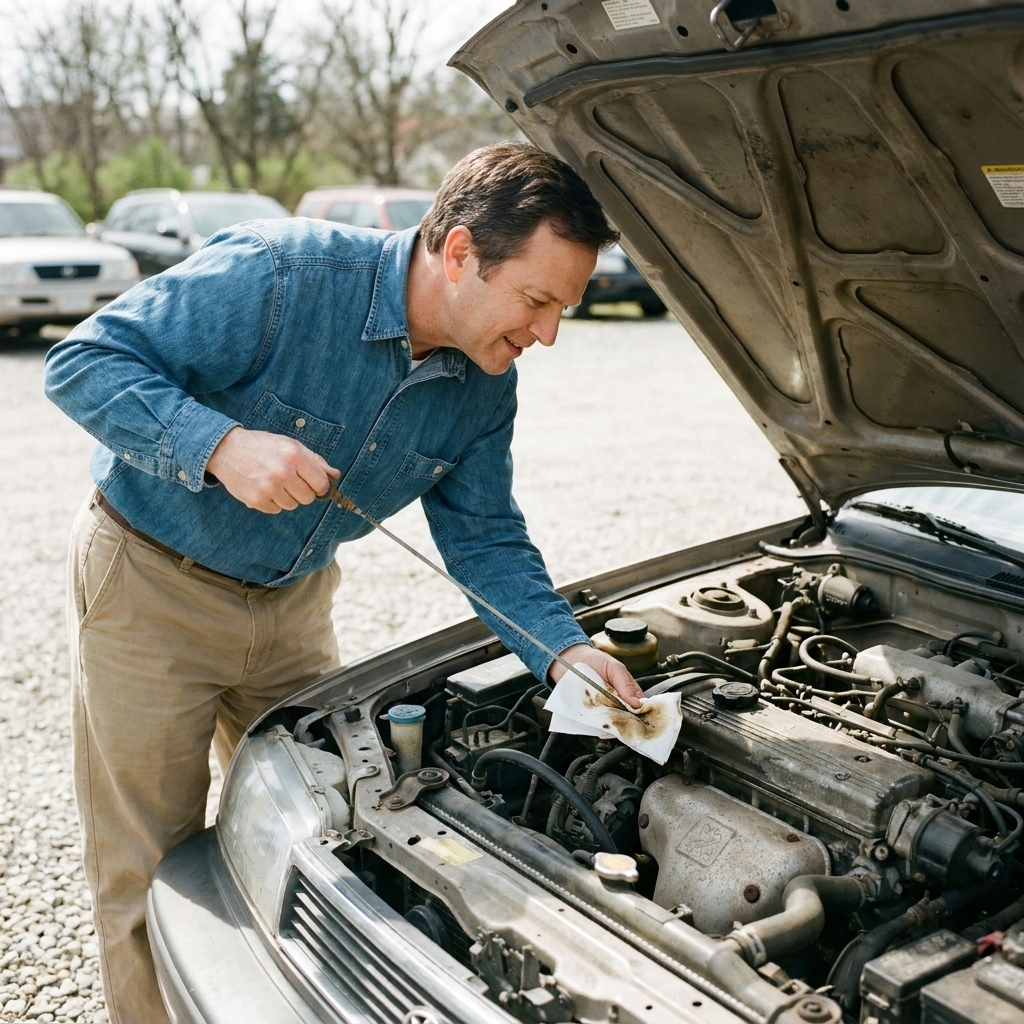
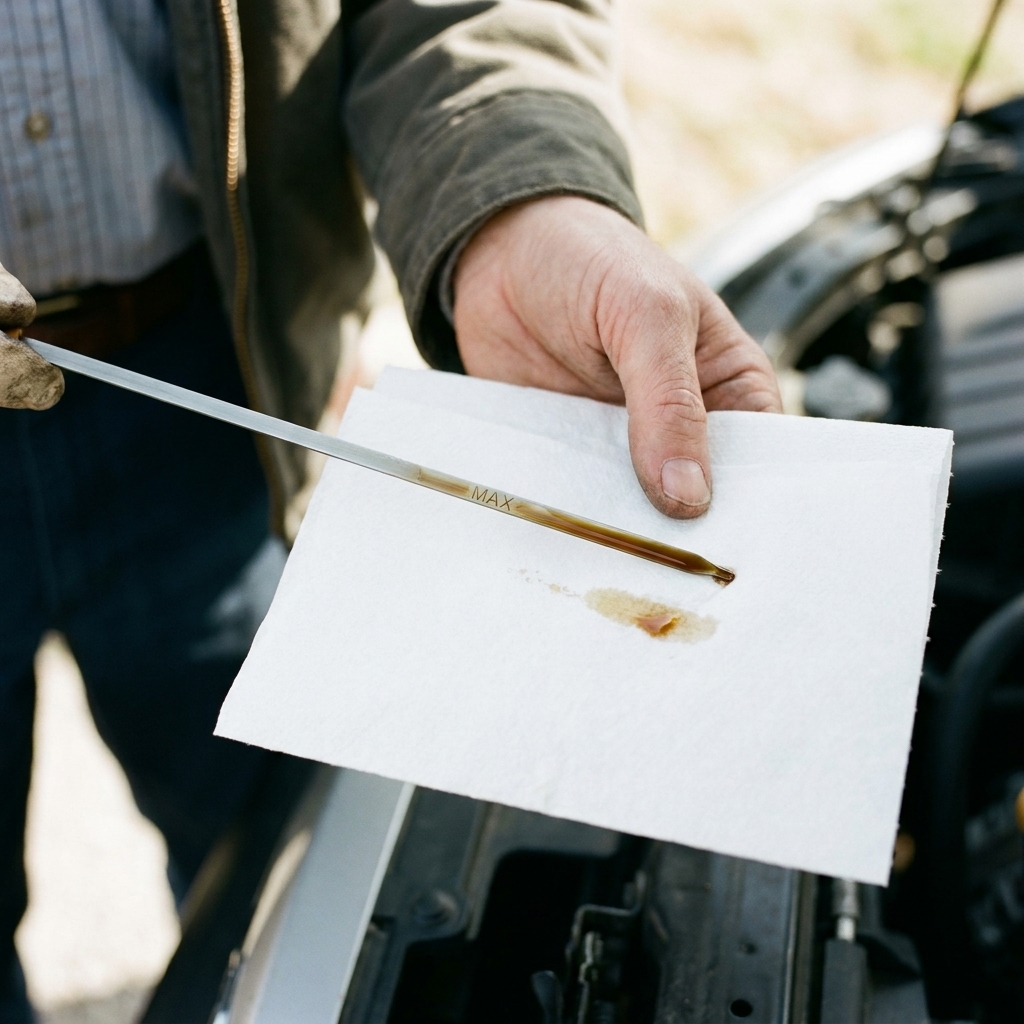
- Find the oil dipstick (often a yellow or orange handle).
- Pull it out, wipe it clean, reinsert fully, then pull again.
- Check the level against the MIN and MAX marks.
- Rub a little oil between your fingers and smell it briefly.
What healthy usually looks like
- Level: between MIN and MAX. Closer to MAX is fine.
- Color: anything from amber to dark brown can be normal, depending on oil age and engine type.
- Smell: mild oily smell, not sharp or fuel-heavy.
- Feel: slippery, not gritty.
Red flags (pause and ask questions)
- Very low oil level: neglect, active oil consumption, or a leak. If it is below MIN, it may have been run low, or it may have dropped recently. Either way, treat it as a serious concern and ask why.
- Strong gasoline smell: possible fuel dilution (short-trip driving, leaking injector, misfire issues). That can accelerate engine wear.
- Burnt smell: heat stress, overdue service, or an engine that has been running hot. Not always a single dramatic overheating event, but still a warning sign.
- Milky tan foam on dipstick: can indicate coolant mixing with oil (possible head gasket or oil cooler issue). A small amount of light residue can also be condensation from short trips, so you need context.
- Gritty particles: internal wear or poor maintenance. Oil should not feel like it has sand in it.
Smart follow-up questions
- “When was the last oil change, and what oil weight did you use?”
- “Any oil consumption between changes?”
- “Any cooling system work or overheating incidents?”
Automatic transmission fluid (ATF)
Transmission fluid can tell you a lot, but the check method depends on the vehicle.
Step 1: See if there is a dipstick
Many newer cars have no ATF dipstick because the level is checked from underneath at a specific temperature. If there is no dipstick, shift your focus to:
- Service records showing the fluid was changed (when applicable).
- How it shifts on the test drive.
- Any transmission leaks underneath.
- If it is AWD or 4WD, ask about transfer case and differential service history. You usually cannot check those fluids easily during a driveway viewing.
If the car has an ATF dipstick
Follow the dipstick instructions if printed. If not:
- Many cars want the engine warm, idling, in Park, after you slowly move the shifter through the gears. Others differ, so treat this as a general guide.
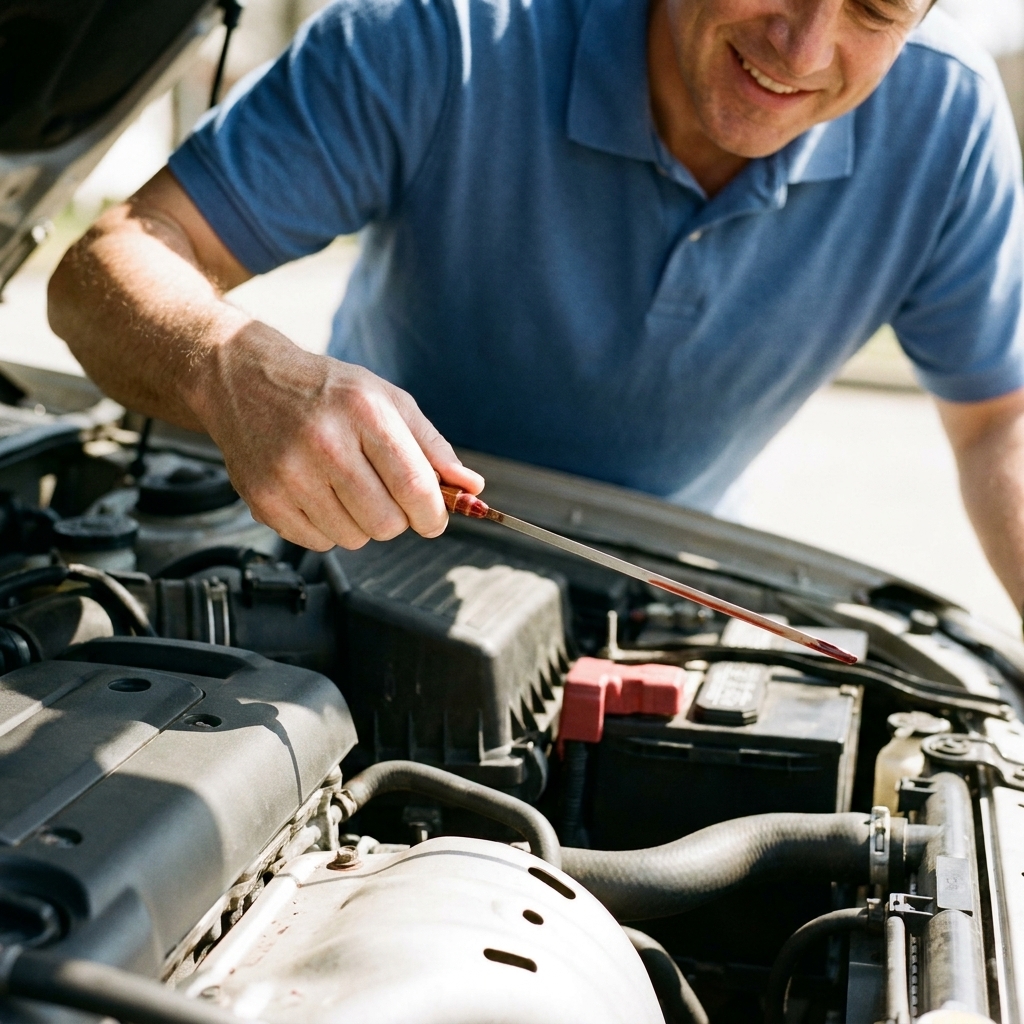
- Pull the dipstick, wipe, reinsert, then read the level.
What healthy ATF looks and smells like
- Color: often red, cherry, or light brown depending on age and type.
- Smell: neutral to mildly oily or chemical. The key is that it should not smell burnt.
- Condition: clear and smooth, not glittery.
ATF red flags
- Burnt smell: the big one. Burnt ATF often points to overheated clutches or chronic slipping.
- Very dark brown or near-black: neglected fluid, heat stress, or both.
- Metallic sparkle: internal wear. A tiny bit of sheen can be normal on high miles, but visible glitter is not your friend.
- Low level: possible leak. Low ATF can quickly damage a transmission.
Test drive tie-in
- From a stop, it should engage Drive and Reverse without a long delay.
- Shifts should be smooth, not flare (rev up) or bang hard.
- On a gentle hill, it should not hunt wildly between gears.
Coolant
Coolant problems are expensive because they often come with overheating. Overheating can warp cylinder heads, ruin head gaskets, and cook seals. So take your time here.
Where to look
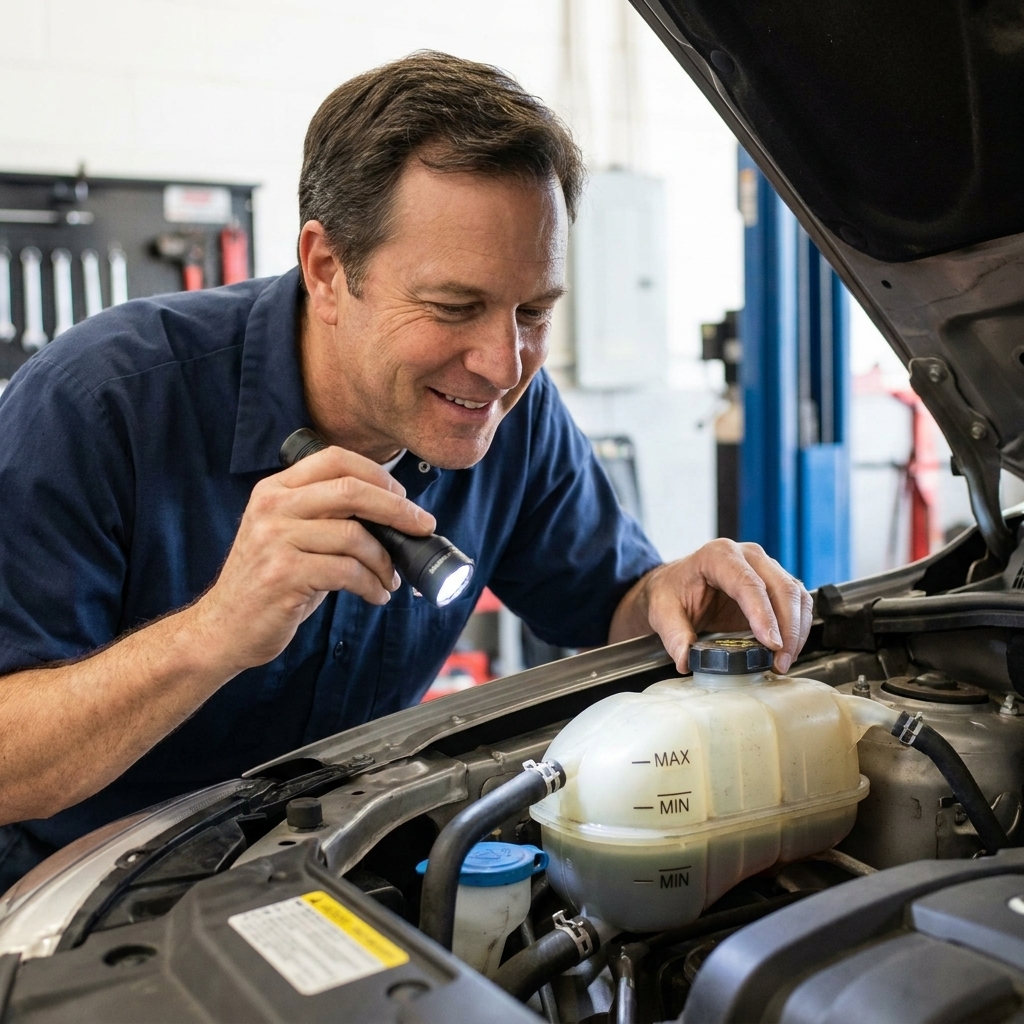
- Coolant overflow reservoir: usually a translucent plastic tank with markings.
- Radiator cap: often metal, sometimes plastic. Only open it when the engine is cold.
How to check safely
- Preferably check with a cold engine.
- Look at the reservoir level against the MIN and MAX lines. Some cars use COLD and HOT marks, so read what is on the tank.
- Look inside the reservoir for sludge or film.
What healthy coolant looks like
- Level: between the reservoir markings when cold (some variation is normal).
- Color: depends on manufacturer: green, orange, pink, blue, or purple are all possible. The key is that it looks clean and consistent, not muddy.
- Clarity: should not look like rusty water or have oily swirls.
One caution about coolant color
Do not use color alone as a compatibility test. Mixing colors does not guarantee it is safe, and some “universal” coolants can still cause issues in certain systems. What matters is using the correct coolant spec for the manufacturer and keeping it clean.
Coolant red flags
- Low coolant level: possible leak, neglect, or the seller topping it off constantly.
- Brown, rusty, or cloudy coolant: corrosion, mixed incompatible coolant types, or neglected service.
- Oily sheen in coolant or mayo-like sludge: potential oil cooler or head gasket issue.
- Crusty residue around hoses, radiator seams, or reservoir: dried coolant from a leak.
- Sweet smell after the test drive: can indicate a coolant leak hitting hot surfaces.
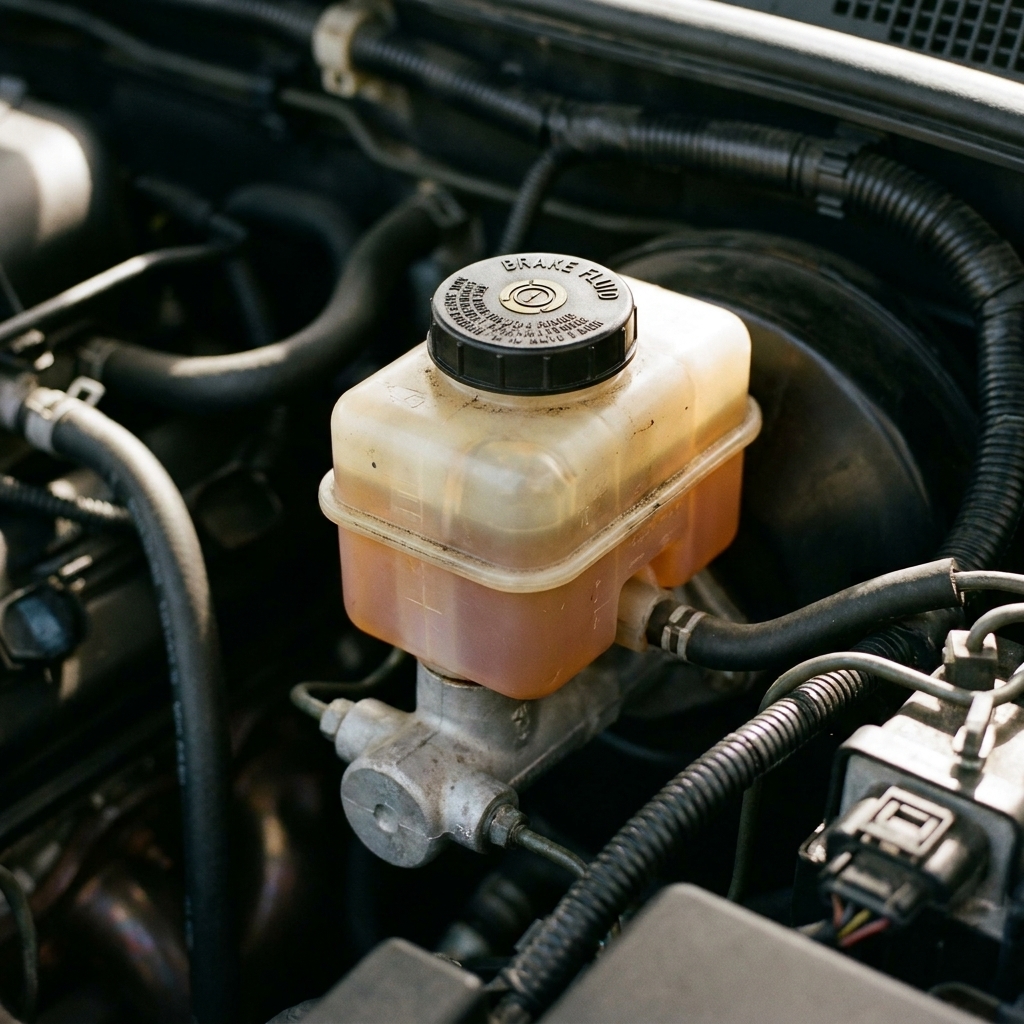
Brake fluid
Brake fluid does not get enough attention because it is not as “sexy” as engine oil. But it is one of the best quick indicators of overall maintenance habits.
How to check
- Find the brake fluid reservoir on the driver side near the firewall (most cars).
- Do not open it unless you have to. Most reservoirs are translucent with level lines.
- Check fluid level and color through the plastic.
What healthy brake fluid looks like
- Level: near the MAX line.
- Color: light yellow to light amber.
Brake fluid red flags
- Very dark brown or black fluid: usually means it has not been flushed in a long time. Old fluid absorbs moisture, which lowers boiling point and can contribute to corrosion in expensive ABS components.
- Low fluid level: can be worn brake pads, a leak, or sloppy maintenance. It is not an automatic walk away, but it does mean you need a closer inspection.
- Wetness around the reservoir or master cylinder: possible leak.
Quick sanity check during the drive
- Brake pedal should feel firm, not spongy.
- Car should stop straight without pulling.
- No brake warning lights should be on.
Power steering fluid (if equipped)
Many newer vehicles use electric power steering and have no fluid reservoir. If you see a steering fluid reservoir or dipstick cap, check it.
- Healthy: clear to light amber or light red depending on the system.
- Red flags: very dark fluid, burnt smell, foamy fluid (air in system), or wet hoses and pump body.
Steering groans, whining, or heavy steering on the test drive can match what you see in the reservoir.
Was the seller topping off?
Fresh fluid is not a crime. But a pattern can be telling.
- All fluids mysteriously perfect, but no records: could be a quick clean-up.
- Oil full but filthy, coolant low, brake fluid dark: suggests only the oil got attention because buyers check it.
- Coolant reservoir freshly filled to the brim: sometimes used to mask a slow leak that shows itself after a long test drive.
If something feels too staged, extend the test drive, let it idle afterward, and look underneath for drips.
Bonus: washer fluid
Windshield washer fluid is not a mechanical deal-breaker, but it is a quick signal of owner habits. An empty washer tank on an otherwise “perfectly maintained” car is not proof of anything, but it is a little data point that fits the larger story.
Printable checklist
Use this simple checklist on your phone notes. The goal is not perfection. The goal is catching expensive surprises before you buy.
- Engine oil: Level (MIN to MAX), color, fuel smell (yes/no), burnt smell (yes/no), milky residue (yes/no)
- ATF (if accessible): Level, color, burnt smell (yes/no), metallic sparkle (yes/no), shifting feel
- Coolant: Level (reservoir markings), color, cloudy or rusty (yes/no), oily sheen (yes/no), crusty residue around hoses (yes/no)
- Brake fluid: Level, color (light or dark), any wetness near master cylinder (yes/no), brake pedal feel
- Clutch fluid (manuals): some cars share the brake reservoir, others have a small separate one. Ask what the car uses and check for leaks if you can see the slave cylinder area.
- Power steering (if applicable): Level, color, foam (yes/no), pump noise on full lock (yes/no)
- AWD or 4WD: Ask for service history on transfer case and differential fluids
- Under-car check: Any fresh drips after test drive (yes/no)
Remember: fluids are indicators, not a final diagnosis. If you see one odd thing, do not panic. Look for patterns, match it to how the car drives, and use a pre-purchase inspection when you are close to buying.
Walk away or negotiate
Usually walk away (or get a pro inspection first)
- Milky oil or oily coolant
- Burnt transmission fluid smell or obvious slipping or flare shifts
- Repeated overheating clues: low coolant plus crusty residue plus temperature gauge behavior
- Active leaks dripping during or after the test drive
Often negotiation items
- Dark brake fluid (plan a flush)
- Old-looking coolant with no overheating symptoms (plan a cooling system service with the correct spec coolant)
- Oil that is dark but at the correct level with clean service records (normal)
If you are unsure, spend the money on a pre-purchase inspection. I have seen too many people spend thousands after the fact because they tried to save a couple hundred up front.
FAQ
Is dark engine oil always bad?
No. Oil darkens as it does its job. I care more about correct level, gritty feel, fuel smell, and whether the seller can show consistent oil change history.
What if the transmission has no dipstick?
That is common. Focus on service records, leaks, and how it shifts. If you are close to buying, a shop can check level and condition properly with the car on a lift and at the correct temperature.
Can I open the radiator cap to check coolant?
Only when the engine is cold. If it is warm, do not open it. Use the overflow reservoir as your main checkpoint during a viewing.
If brake fluid is low, does that mean there is a leak?
Not always. As brake pads wear, the fluid level in the reservoir can drop. But low fluid still deserves a careful look at pad thickness, calipers, and brake lines.