Stop negotiating monthly payments. Learn how to focus on the out-the-door price, spot common add-on tricks, and lock in a clean used-car deal.
Used Car Buying Guide
How to Decline Extended Warranties and Dealer Add-Ons
A step-by-step guide to the finance office: how vehicle service contracts work, which dealer add-ons to skip, and the exact phrases to politely decline or negotiate the ones you want.

Ben Sullivan
Ben Sullivan is a former ASE-certified mechanic with over 15 years of experience inspecting, repairing, and appraising used vehicles. He contributes to Car Wise Guide to help everyday buyers navigate the used car market with confidence, armed with the knowledge to spot hidden red flags and negotiate fair prices.
Published October 18, 2026
Updated October 18, 2026
The test drive is done, you agreed on a price, and now you are headed into the finance office. This is where a lot of used car deals quietly get expensive.
I have watched plenty of smart, careful buyers get worn down by rapid-fire offers, scary repair stories, and “just sign here” paperwork. The good news: you can keep control without being rude or turning the room into a standoff. You just need a plan and a few lines you are comfortable repeating.

Know what you are walking into
The finance and insurance office (often called F&I) is where contracts are finalized. It is also a profit center for the dealership. That is not a moral judgment, it is just how the business works.
Most offers in F&I fall into three buckets:
- Extended warranties (vehicle service contracts) that promise to cover certain repairs after purchase.
- Protection products like GAP insurance, tire and wheel coverage, paint protection, and key replacement.
- Convenience or security add-ons like VIN etching, window tint, nitrogen in tires, trackers, and alarm systems.
The biggest mistake I see is buyers negotiating the car price hard, then mentally checking out in F&I. Treat this room like part two of the negotiation, because it is.
Before you sit down: set your rules
Rule 1: Your out-the-door number is the main number that matters
If you remember only one thing, remember this: negotiate and judge everything using the out-the-door (OTD) price. That includes the vehicle price, dealer fees, taxes, registration, and every add-on.
Use this early: “I am only making decisions based on the out-the-door total. Please show every product as a separate line item and update the OTD number each time.”
Rule 2: Monthly payment talk can hide expensive add-ons
F&I will often frame products as “only $19 a month.” That sounds harmless, but it can add up to thousands over the term of the loan, plus interest.
Try this: “I am not discussing monthly payment changes. What is the total cost of the product, and what does it cover?”
Rule 3: “No” is a complete sentence, but you can be polite
You do not owe anyone a detailed explanation. If you want to keep it friendly:
- “No thank you, please remove that.”
- “I am going to pass on all optional products today.”
- “If it is optional, I am declining it.”
Step-by-step: the finance office
Step 1: Ask for a clean buyer’s order
Before you talk products, ask to see the breakdown of the deal as it stands.
Ask: “Can I see the buyer’s order with the itemized out-the-door total before we add anything?”
Look for surprise fees and pre-loaded add-ons. Common ones include “appearance package,” “anti-theft,” “etch,” “tire protection,” and “reconditioning fee.” Some are negotiable, some are not, but you cannot challenge what you cannot see.
Step 2: Decline everything once, clearly
This sounds blunt, but it saves time and reduces pressure.
Say: “Before we start, I am declining all optional add-ons and warranties. If there is one you think truly fits my situation, tell me which one and the total price, and I will decide.”
Step 3: Slow the pace and control the paper
Fast talking is a tactic. You are allowed to read.
Say: “I am going to take a minute to read each page. I do not sign anything I have not read.”
If you need more time, ask for copies. In many cases you can request the contracts be printed or emailed so you can review them carefully before you sign.
Step 4: If you want something, negotiate one product at a time
Avoid negotiating by piling products together. Bundle pricing hides profit.
Say: “Let’s handle GAP first. If we agree on that, then we can talk about anything else.”
Step 5: Confirm what is optional and get the cancellation terms
For any product you consider, ask two questions:
- “Is this required to buy the car or get approved?”
- “What is the cancellation process and refund timeline?”
If they claim something is required, ask to see that requirement in writing from the lender. Most add-ons are optional, but lenders can require things like proof of insurance coverage (typically comprehensive and collision on a financed car). Some specialty programs may also have their own rules, so do not guess. Verify.
Outside financing: keep options open
If you walk in with a pre-approval from a credit union or bank, you are harder to pressure. Even if you plan to use dealer financing, outside financing gives you a clean comparison.
- Compare APR, term, and total finance charge. A low payment can still be an expensive loan if the term is long or the rate is higher.
- Keep the conversation on numbers, not feelings. “What is the APR and term you can approve me for today?”
- Do not assume the dealer is worse. Sometimes they can beat your rate, but make them prove it on paper.
Extended warranties: when they help
First, let’s clear up a common confusion. What most people call an “extended warranty” at a used car dealer is typically a vehicle service contract, not a warranty like the factory warranty. Coverage depends on the contract, the administrator, and the fine print.
When an extended warranty can be worth considering
- You are buying a higher-mileage used vehicle with complex, expensive systems (turbocharged engines, air suspension, advanced infotainment).
- You cannot absorb a sudden $2,000 to $5,000 repair without going into high-interest debt.
- The contract is exclusionary (covers “everything except…”), from a reputable administrator, and you understand the exclusions.
- You plan to keep the car long enough to benefit from the coverage period.
When it is usually a bad deal
- The car is known for strong long-term reliability, and the contract cost would cover most likely repairs anyway.
- The contract has lots of exclusions or low payout limits, or it requires approvals that delay repairs.
- It is priced into your loan, increasing interest cost on top of the product price.
- The deductible, claim caps, or “wear item” exclusions make it functionally weak for common problems.
How to decline a warranty
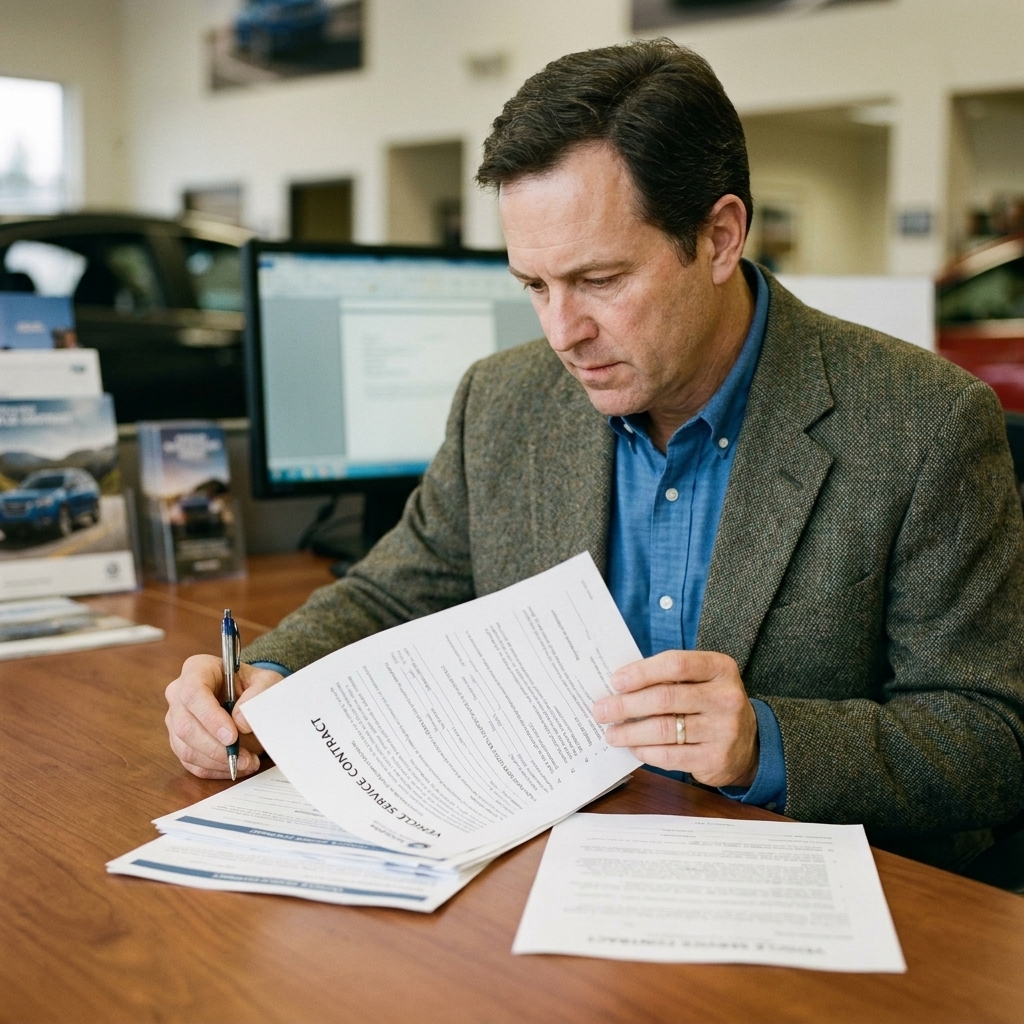
Most pushback comes from two angles: fear and “value.” You can defuse both calmly.
If they use scary repair stories
Say: “I hear you. I am choosing to self-insure instead. Please remove the service contract and update the out-the-door total.”
If they say “you will regret it”
Say: “I understand. My decision is no. If I change my mind later, can you show me whether I can purchase it after today, and at what price?”
Some contracts can be bought later. Many times, the “today only” urgency is sales pressure, not reality.
If they keep pushing different coverage levels
Say: “I am not shopping coverage levels. I am declining coverage entirely.”
Dealer add-ons: skip vs consider
Here is my straight-shooter take after years of inspections and watching buyers pay too much for stuff that looks good on paper.
Usually skip these
- VIN etching: Often $200 to $500 for something you can get far cheaper elsewhere. It may help in some theft situations, but the real-world benefit is often limited compared with the price.
- Nitrogen tire fill: Air is already about 78% nitrogen. The performance difference is minimal for daily driving.
- Paint “sealant,” fabric protection, ceramic packages: Sometimes the product is fine, but the price is usually inflated and the prep work varies wildly.
- Rustproofing add-ons sold generically: Real corrosion protection is regional and product-specific. A one-size pitch is a red flag.
- Pre-installed accessories you did not ask for (pinstripes, door edge guards, cheap window tint): If you do not want it, do not pay for it.
- Market adjustment add-ons disguised as protection packages: If it smells like markup, it is markup.
Sometimes worth it at the right price
- GAP insurance: Worth considering if you are putting little money down, rolling negative equity, or financing a long term. It is often cheaper through your auto insurer or credit union, so compare. Also note: while GAP is usually optional, a few specialty lenders or buy-here-pay-here programs may require it.
- Tire and wheel coverage: Can make sense if you live where potholes are brutal and you have larger wheels with low-profile tires. But only if exclusions are reasonable and the price is fair.
- Key replacement: Modern smart keys can be expensive. If you are the type who loses keys, it may pencil out.
- Short, basic service plan (oil changes) at a realistic price: Only if you do the math and would actually use it.
How to negotiate add-ons
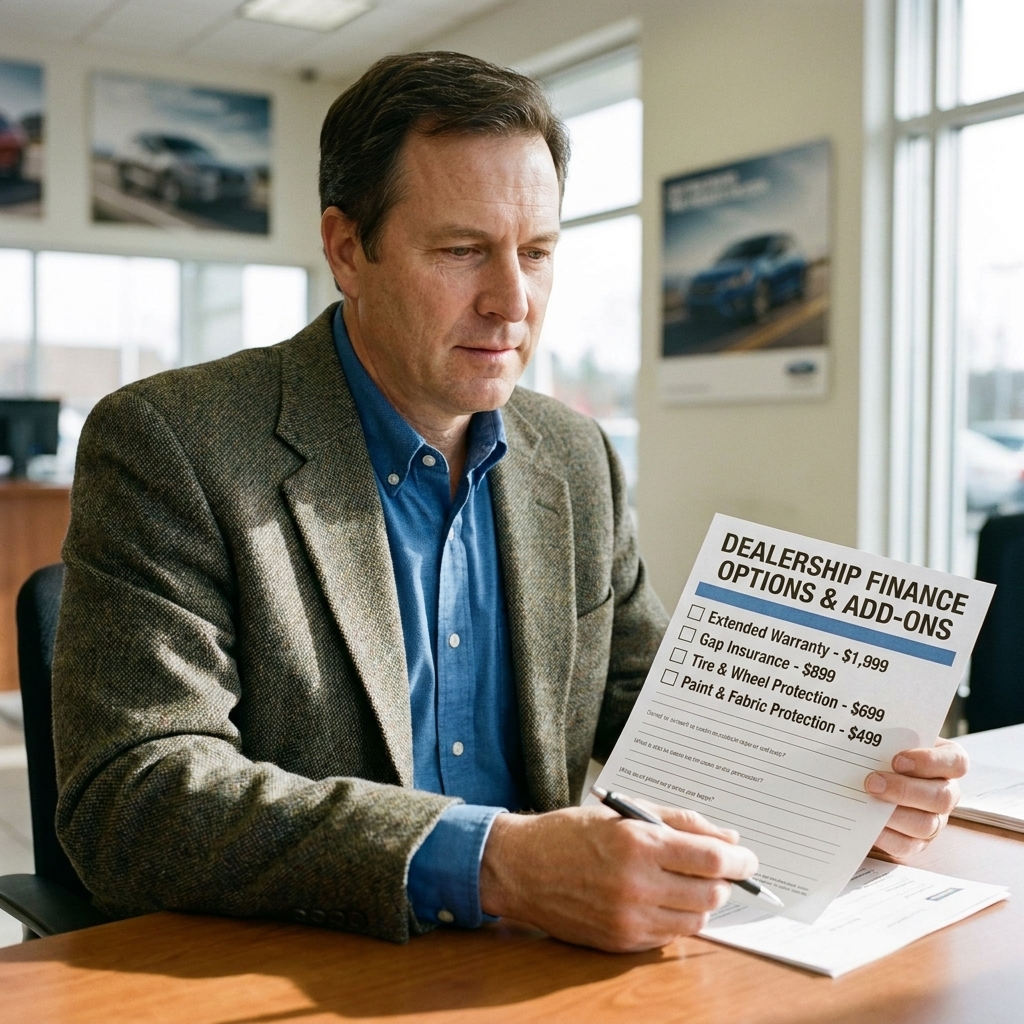
If you want one product, negotiate it like anything else: with a target price and a willingness to walk away.
Use this three-step approach
- Get the product details in writing. Ask for the brochure or contract, not just a verbal summary.
- Ask for the cash price. “What is the price if I pay cash for this today, not rolled into the loan?”
- Anchor with a lower number and stay quiet. “If you can do $___ for it, I will add it. Otherwise I am passing.”
What is a fair price?
There is no universal number because providers and coverage differ, but here is the practical truth: many dealer products have significant markup. It is often possible to get a meaningful discount if you push politely, especially when the first quote is high.
If they will not move, your leverage is simple: “No thanks.”
Negotiate the right thing: total cost, not monthly
Say: “I only care about the total price of the product, not the payment impact.”
Pressure tactics and replies
“Everyone gets this”
Response: “I am not everyone. Please remove it.”
“It is already on the car”
Response: “If it is optional, I am not paying for it. Remove the charge or we do not have a deal.”
If they truly refuse, you decide if the car is still worth it. But do not let “already installed” turn into “you must pay.”
“The lender requires it”
Response: “Show me the written lender requirement. If it is optional, I am declining.”
“This price is only good today”
Response: “Understood. Today my answer is no.”
“Sign here and we will fix it later”
Response: “No. If it is not correct on paper, I am not signing.”
Spot delivery: do not get yo-yo’d
Sometimes a dealer will let you take the car home before financing is fully finalized. That can be fine, but it can also lead to “yo-yo financing,” where you get called back and pressured into a higher rate, a longer term, or new fees.
Protect yourself: ask whether the deal is final or conditional, and get the answer in writing. If the terms are not final, be careful about leaving your trade-in and be clear about what happens if the lender does not approve the contract as written.
Your simple script
If you want a ready-to-use script, here it is. You can say it word-for-word.
- “I am declining all optional products. Please show me the out-the-door total with just the car, taxes, registration, and required fees.”
- “If you believe something is required, please show me where it is required in writing.”
- “I am not discussing payments. What is the total cost?”
- “No thank you, please remove that and reprint the buyer’s order.”
- “I will read each page before I sign.”
Paperwork red flags
- Products added without your signature or initials next to the line item.
- Numbers that do not match what you agreed to in the sales office.
- Duplicated fees (documentation fee plus “processing” fee, for example).
- Vague product names that do not clearly state what you are buying.
- Long loan terms that make add-ons look small monthly but expensive overall.
Also separate required items from optional ones. Taxes, title, and registration are real. Some dealer fees may be set by the store or regulated by the state, so you might not be able to delete the fee, but you can still negotiate the overall out-the-door price to offset it.
If something looks off, stop. Ask them to correct it. If they will not, be ready to walk. Walking is not dramatic. It is how you avoid getting nickeled-and-dimed into a bad deal.
FAQ
Can a dealer refuse to sell me the car if I decline the warranty?
They can choose not to do business, but in the vast majority of normal used car deals, the warranty is optional. If you feel you are being forced, ask for the requirement in writing and be prepared to shop elsewhere.
Is GAP insurance worth it on a used car?
Sometimes, yes. If you are financing most of the purchase, rolling negative equity, or choosing a long loan term, GAP can protect you if the car is totaled while you owe more than it is worth. Price it through your insurer and credit union too, because pricing varies a lot.
Can I cancel an extended warranty after I buy it?
Often yes, but rules differ. Many contracts have a cancellation window and may refund a prorated amount. Always ask for the cancellation terms before you sign, and keep copies of everything.
What if the car has add-ons already installed like tint or a tracker?
You have three options: negotiate the price down to offset it, insist the charge is removed, or walk away. Do not let “already installed” pressure you into paying a marked-up price for something you did not want.
Is there a 3-day right to cancel a car purchase?
In many places, no. Do not assume you can unwind the deal after you sign. Read before you sign, and make sure the numbers match what you agreed to.
My bottom line
The finance office feels uncomfortable because it is designed to. Slow it down, focus on the out-the-door total, and remember that most add-ons are optional unless proven otherwise in writing.
If you want a protection product, pick it on purpose and negotiate it. If you do not, say no once, calmly, and make them print the paperwork without it. That is how you leave with the used car you chose, at the price you agreed to, without the extras you never wanted.